
Cass County Municipal Court Warrants
Most states hand city tickets to a city or town court. Minnesota does not. District courts hold jurisdiction over local ordinance violations, so a municipal warrant in Cass County is really a district court order. Cass County has one district court location, in Walker. Every city ordinance case filed in the county gets heard there. The courthouse itself dates to 1907. It still houses the county's judicial business. The public counter in that building is where a case question gets a real answer.
Cass County Municipal Warrants in Court
An ordinance case in Cass County begins like any other, with a citation or a complaint. The difference is the charge. It points to a city code section rather than a state statute. District court hears the matter either way. The paperwork still gets a case number and a response date. Ignore it and the court can issue a warrant. Minnesota Rule 6 requires the same notice, so a local citation warns that missing a court date or failing to contact the court can bring an active warrant. That warning has teeth. The court that issues the order and the city that wrote the ordinance are two different actors. Only the court can change a case status. So a Cass County warrant question goes to the bench, not city staff. The Cass County courthouse history page traces the Walker building where these cases are heard. It is context, not a records source. The case file sits with Court Administration.
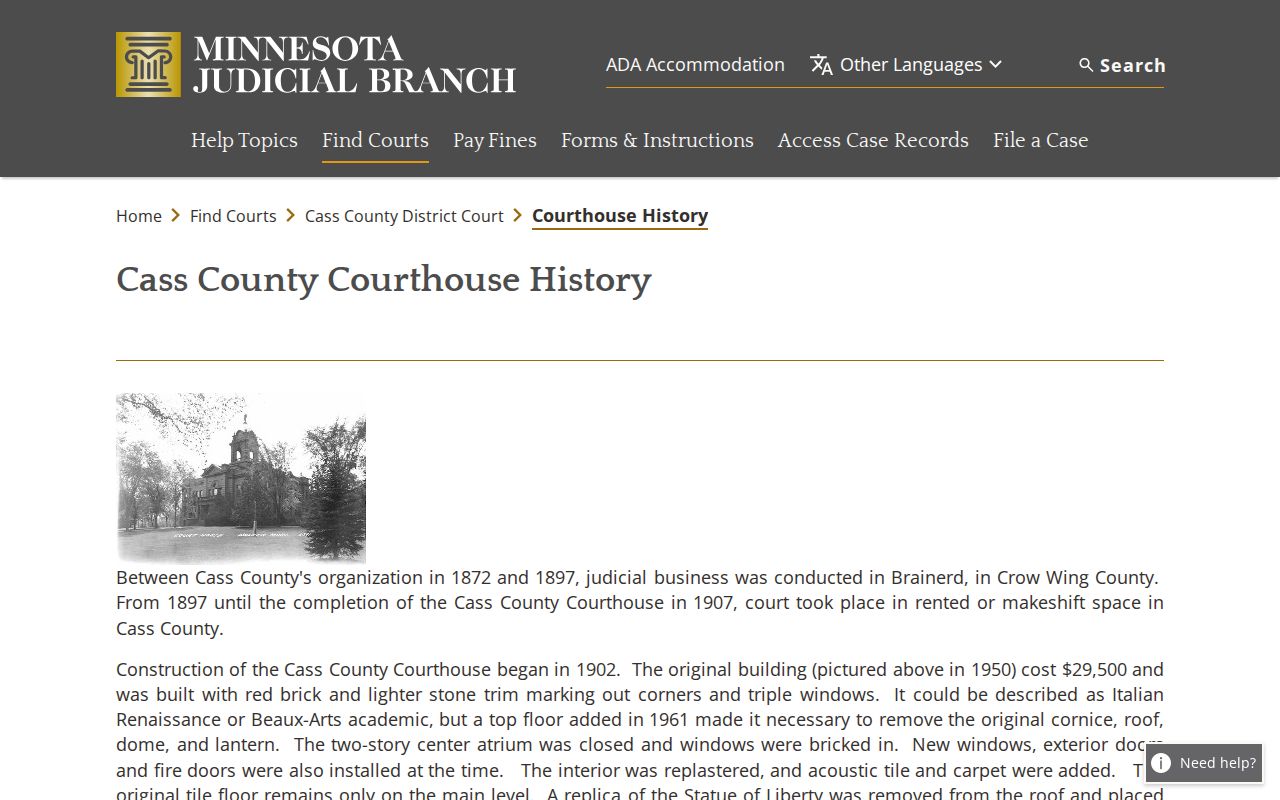
Plan an in-person visit around weekday counter hours rather than around the courthouse's history.
Cass County Cities With Municipal Courts
None of Cass County's five largest cities runs its own criminal court. None posts a city warrant portal either. What each city offers instead is a law enforcement channel or a records contact, and the table below lays out what a resident actually finds.
| City | Local police channel | Where an ordinance case goes |
|---|---|---|
| Lake Shore | City police department | Cass County District Court |
| East Gull Lake | No city department listed | Cass County District Court |
| Walker | City police, county dispatch | Cass County District Court |
| Pine River | City police department | Cass County District Court |
| Cass Lake | County dispatch, tribal police | Depends on the issuing court |
The state's judicial directory for Cass County lists one district court and no separate municipal bench. A quick look confirms the single-court structure. That saves a wasted trip to the wrong office.
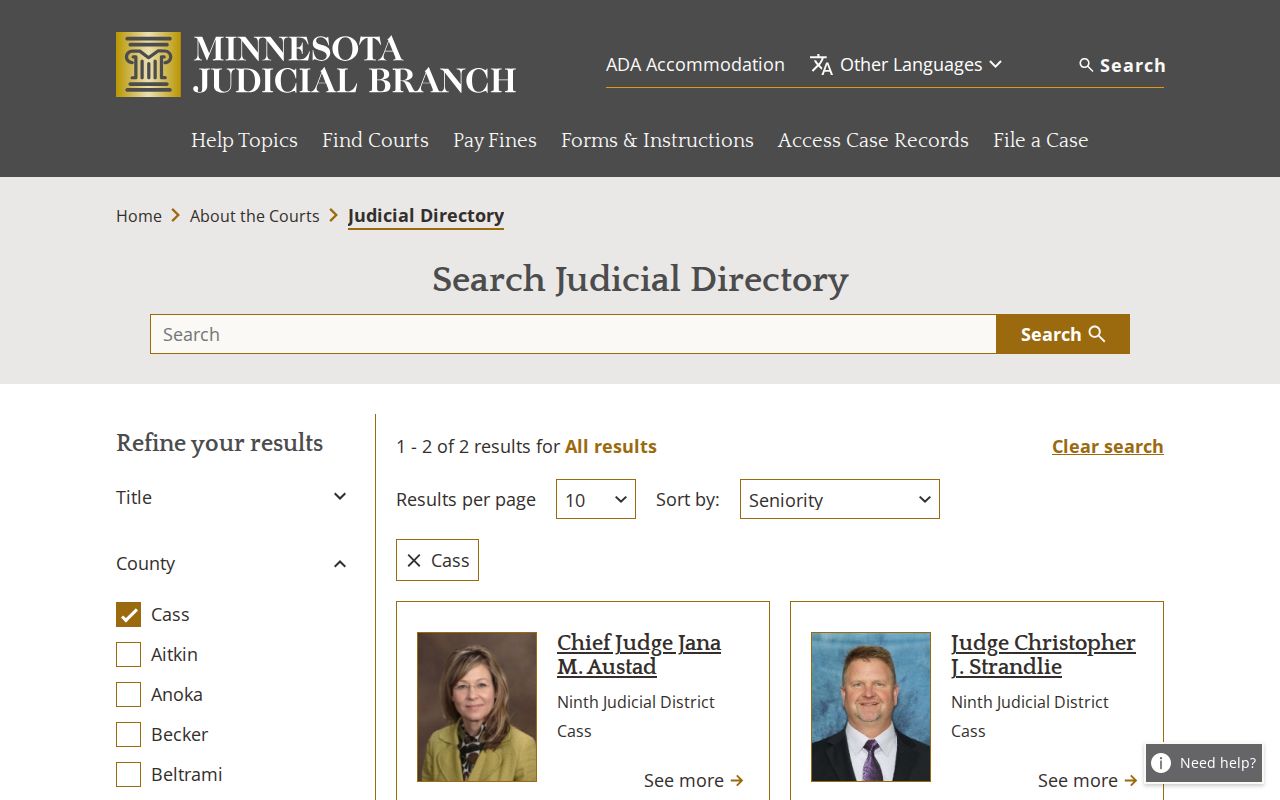
Check the directory entry before assuming a city handles its own ordinance cases.
Walker Police and Cass County Warrants
Walker is the county seat. Its police department is the largest city agency in this Cass County group, with five sworn officers. Calls to its public number roll to the Cass County Sheriff's Office dispatch center, since the officers are on the road and no administrative staff works the office. A caller asking about a citation reaches a dispatcher first. The department does publish its policy documents. They cover impartial policing, use of force, and body-worn camera rules. Those pages show how the agency operates. They are not a warrant list. The court still owns that case status.
Checking a Municipal Court Warrant
Checking an ordinance case follows the same path as any other Cass County case. It just adds one step up front.
- Read the citation or notice for the city, the case number, and the court named on it.
- Call the city police department if you need the incident record rather than the case status.
- Search Minnesota Court Records Online by case or citation number.
- Call the district court at 218-888-5150 and ask what the case shows.
- Ask whether the case needs an appearance, a payment, or a recall step.
A city case can land on the sheriff's daily warrant list once a court order follows it. A citation that stays payable usually will not appear there. That is why the court answer comes last in a Cass County warrant check. It also carries the most weight.
East Gull Lake Warrants and Cass County
East Gull Lake ranks second in size on this list, yet its official pages describe a city administration with six full-time employees, no police department, and no municipal court. That absence is information, not a gap. Read the agency named on the document. The issuing authority may be the sheriff rather than a city office. Geography raises the stakes. East Gull Lake sits beside Crow Wing County. Living near another county does not change the county named in a Cass County court case. The paperwork controls.
Inside a Municipal Court Warrant
An ordinance warrant carries the same core details as any other Cass County court order, just with a local charge attached.
| Case number | Filed by the court. It can read CR-##-###### for a case with an appearance requirement. |
|---|---|
| City and ordinance | The code section the citation names, which is not a conviction. |
| Issuing court | Cass County District Court for cases filed in this county. |
| Fine amount | Set by the court's fee schedule rather than by the city. |
| Status | Open, paid, appeared, failed to appear, or recalled. |
| City record | Held by the city police custodian when a city officer wrote the citation. |
City Portals Versus Cass County Warrants
A city payment page and a court payment page are different doors. East Gull Lake and other cities collect utility bills online, and Cass County runs a general payment option for county obligations. Neither was built for court fines or bond. Those payments go through the state's Pay a Fine system, which lists online, phone, mail, in-person, and payment-plan routes. Pay the wrong office and the case stays open. Confirm what obligation you owe. Ask the court whether a payment also resolves the warrant.
Tribal Warrants and Cass County Court
Cass Lake sits inside the Leech Lake Indian Reservation. Its city contact page points residents to Cass County dispatch at 800-450-2677 and the Leech Lake Tribal Police Department at 218-335-8277, with no city police department listed. So one phone call can land you in the wrong place fast. Read the citation first. The court or agency named on that paper tells you who actually holds the case.
A tribal matter runs through tribal court. A state case filed in Cass County runs through the district court instead, and blending the two sends people to offices that cannot help. The case number printed on the document is the quickest way to tell which system you are in, so start there before dialing either number in Cass County.
Pine River Warrants and Cass County Files
Pine River posts a police data request form on its city site, plus a general data request form alongside it. Both work under Minnesota's data practices law. The city itself handles them, since it keeps its own reports. A request like that can get you a report or an incident record from the city files.
It is not a warrant lookup, though. No form changes what a court has ordered. Send records requests to the city holding the report, and send case questions about a Cass County matter to the district court that issued the order. Keeping those channels straight saves a round of calls.
How to Resolve a Municipal Court Warrant
Resolution happens in court, not at city hall. Call Court Administration, ask what the case shows, and follow what the judge requires. A payment may settle a payable citation, while a more serious charge usually demands an appearance. Only the Cass County court can recall a warrant, so a city clerk cannot clear one for you.
Key Rules:
Minnesota district courts hear city ordinance cases, so most local warrants are district court orders.
City payments, county payments, and court payments go to different places, and only the court closes a case.
City police records requests follow the Minnesota Government Data Practices Act, chapter 13.